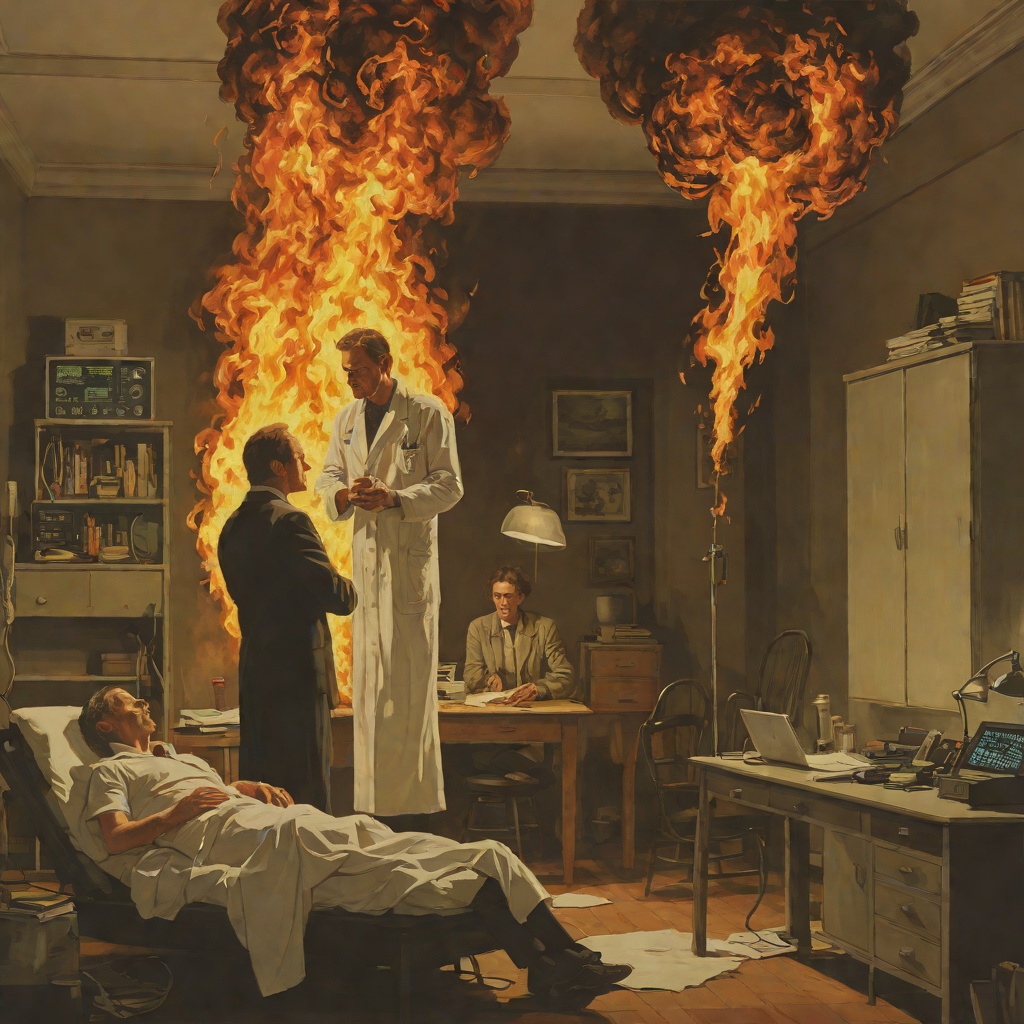
Deny everything
Die, My LoveThe rule “Deny everything” is a compact survival tactic in the narrator’s marital conflict, where incriminating objects, dreams, and evasive answers compete to establish what has happened. Its decisive force lies in its escalation: denial begins as advice for resisting evidence, becomes a method of withholding the identity of a suspected lover, and finally threatens to deny the self as well.
Definition and Immediate Context
The rule appears while The Narrator and The Husband are arguing over two apparently incompatible forms of evidence. The Husband reports a dream in which he found The Narrator in bed with the neighbour, while The Narrator points to the condoms discovered in the car’s glove compartment, melted by the sun of the infernal summer. Their conflict therefore has both a psychological and material beginning: a toxic dream and a physical object that seems to demand explanation. The rule enters this unstable space as a general principle, expressed through the claim that everything should be denied even when evidence is present.
The advice is not presented as a calm legal strategy. The entire dispute has already taken the form of sermons, questions, and evidence, with the couple verbally attacking one another while military planes practise overhead. The planes rehearse a war that is already ending, an image that makes the rule’s logic unmistakable: denial continues after the conflict’s apparent facts have been assembled, because the real contest is no longer simply over what occurred but over whether any shared account can be imposed on it.
How the Rule Operates
“Deny everything” first functions as a refusal to accept the evidentiary force of the condoms. The Husband asks what they were doing in the glove compartment and presses The Narrator for an answer. She counters that he has not actually asked a question, turning the exchange from a demand for facts into a dispute about the form of interrogation itself. The rule thus works by shifting attention from the object to the conditions under which the object can be interpreted.
Its most extreme formulation is the narrator’s willingness to deny not merely an accusation but personal identity. In the middle of the argument, the principle expands from “deny the evidence” to the possibility of denying who one is. That movement gives the rule a psychological depth absent from ordinary evasiveness. It offers protection against exposure, but only by loosening the connection between the speaker, the body, and the truth that others claim to recognize.
The rule also governs the treatment of the neighbour. The Husband wants to know who the man is, identifies him as the person who appeared in the middle of the night and passes daily on the neighbour’s motorcycle, and threatens to confront him. The Narrator answers that he is no one, although she feels The Husband’s gaze like a kitchen knife at her throat whenever the neighbour comes closer. The denial therefore does not erase the suspected rival; it makes his presence more oppressive. “No one” becomes an active concealment whose very insistence preserves the hidden figure’s power.
Denial, Desire, and the Body
The rule’s verbal evasions are accompanied by imagery that makes concealment bodily rather than merely conversational. The Narrator describes women as barefoot and naked, entering and closing themselves within a private wood wrapped in foliage. This image turns secrecy into an enclosed landscape, while the suspected sexual encounter is rendered through animal and predatory comparisons: the lover enters like a snake entering a crocodile’s mouth and makes space with a single machete slash. The language does not clarify the affair; it gives the withheld truth a physical, invasive form.
The Narrator refuses to tell The Husband what happened, even when he promises to leave her alone if she admits that she is sleeping with the other man. Her repeated denial is therefore both defensive and self-dividing. The lover’s entrance is imagined as producing an echo of her own voice inside a darkened body, where he kills her. Desire and self-erasure become inseparable: what is concealed from The Husband is also described as an experience that destroys the speaking self from within.
Consequences in the Marital Conflict
The rule does not preserve peace. Instead, it carries the couple from suspicion into physical violence. The Husband’s insistence that The Narrator is a two-faced liar is followed by accusations, kicks, blows, and banal insults. The sequence shows denial failing as a stabilizing device: rather than closing the dispute, it intensifies the demand for confession and makes the body the site where the unanswered question is pursued.
The immediate consequence is The Narrator’s flight. She runs outside and, for the first time, crashes straight through the glass. Covered in blood, she crosses the pastures as though they were a park, trampling rabbits and barn owls, before lying in her kennel, described as a cave among pruned trees. The scene externalizes the rule’s logic. Speech has refused to yield a coherent truth, so the conflict ends in broken glass, blood, animal imagery, and withdrawal from the marital house.
Afterward, The Narrator remains on the ground with wet socks, dried blood on her body, and cold shaking overtaking her. The long night that follows is spent looking at graves until sunrise, brushing her hair, sleeping beneath reflected tombstones, and reading the names of dead people she never knew. Denial has therefore moved from a tactic within an argument to a condition of existence: the narrator imagines that this life among graves may be the life awaiting her from then on.
Narrative and Thematic Significance
As a narrative device, “Deny everything” makes evidence unstable without making it disappear. The condoms remain concrete, the dream remains emotionally consequential, and the neighbour remains perceptible through his repeated motorcycle visits, yet none of these facts produces a mutually accepted explanation. The rule exposes the gap between seeing an object and possessing the authority to say what it means.
The phrase also operates as a speech act whose practical effect contradicts its apparent promise of control. It is meant to prevent evidence from becoming confession, but it produces interrogation, jealousy, violence, and flight. Its final irony is that denial cannot abolish truth; it can only redistribute truth into gestures, images, bodily wounds, and the narrator’s refusal to name the man who has become “no one.” In this episode, the rule protects secrecy at the cost of shared reality, and its apparent defense of the self culminates in the self’s estrangement from home, body, and language.